(866) 850-9555
help@netcancerawareness.org

NETSTalk

Thorns and Roses.

November 1, 2022

By Anne Dabbs, 
NCAN TN Chapter Leader, NET Patient

Some people are naturally optimistic. Others of us have to work hard at seeing our glasses as half full. Those of us living with a chronic disease such as Neuroendocrine Cancer often find ourselves needing to cultivate a new type of optimistic attitude.

As a popular saying goes, you can give an optimistic person a long stem rose and they will see only the bloom while a pessimist will only see the thorns. I doubt we can totally change our natural tendencies, but we can and we must find a mind set to address our disease with a resilient attitude.

“We don’t see things as they are. We see things as WE are.”
So very true. On the days that we are struggling, try to remember that your emotions may be just tied up in today’s particular struggle or set back. We all need a “pity party” every so often. Don’t be the last one to leave your pity party. Just do it, learn from it, and then let it go.

“Imagination manifests reality.”
Make sure you keep your mind focused on the diagnostic and medical facts of your disease and current health. Don’t look for trouble needlessly. Good thoughts vs negative thoughts can not share space in your brain 50/50. Make room for the good thoughts, the positive thoughts, and let them prevail.

“You learn everything you need to know about a person by the way they talk to you.”
Especially now, seek out and surround yourself with those who hear you. You know deep in your heart who asks sincerely “how are you?” and who is asking just to make conversation. Allocate your time and energy wisely. Keep in mind, however, that your words are a reflection of yourself to others. Make sure your words portray yourself as you want to be seen and heard.

“Survival of the fittest is all about evolution.”
So many things in your life have changed since your Nets diagnosis. They will continue to change. Now more than ever, we must be willing to close a few doors, pass on some prior opportunities, and evolve into a lifestyle that we never before anticipated. Try to stay centered on what lies ahead and allow only brief glances into your rear view mirror.

“Gratitude makes everything easier.”
Yes, even living with Neuroendocrine Cancer, there are many, many things to be thankful for. Some days we must look a little harder. Some days gratitude is a struggle. Every day is filled with thorns and roses. When the thorns seem to be winning and multiplying, oh so fast, look harder and deeper for the roses. Make peace with those thorns and allow yourself to treasure those roses. However small, finding them and acknowledging them is a triumph for your day.

Share some of your roses below. And if you find yourself struggling with the thorns, give us a call. We are here for you.

Find out more about how YOU can help the NET Community.


Disclaimer: NCAN blog posts are the opinions of its writers and are not intended as a replacement for medical advice. Please consult your Health Care Providers for individual concerns.

Read more

Top Ten Reasons To Attend The NCAN National Conference In Atlanta.

October 15, 2022

By Anne Dabbs, 
NCAN TN Chapter Leader, NET Patient

Top Ten Reasons To Attend The NCAN National Conference In Atlanta.

10. No where else can you listen to and visit with 20+ expert physicians and advocates for Neuroendocrine Cancer in one location.

9. Where else can you meet so many people genuinely interested in your diagnosis, incisions, and surgeries?

8. NCAN has been providing educational and emotional support to Neuroendocrine patients and family members since 2003.

7. Black and white looks good on everyone and is always fashionable.

6. Good food! And plenty of it! (Did I mention grits?)

5. Fun Social events including a Comedy show staring Emmy Award winning comedian and NET Patient, Steve Mazan!

4. The Opportunity to talk directly with Numerous Neuroendocrine advocates and Pharmaceutical representatives.

3. Sharing problems with friends can reduce stress by 80%.

2. Meeting other Neuroendocrine patients is a validation of your status as a rare disease patient.

And the NUMBER 1 reason to attend an NCAN NATIONAL CONFERENCE?

1. Attendance is an investment in your health and well-being. The presentations refresh your knowledge and introduce you to new advancements allowing you to become your own best advocate. You will make new friends, meet patients and NET specialists. The connections and Networking opportunities can develop a support system that is unique to patients with rare diseases. You will leave Atlanta after 2.5 days with increased assurance, direction, inspiration. And Hope.

REGISTER HERE

We look forward to meeting you in Atlanta. (We will be the ones wearing zebra stripes.)

And if we can help in any way before then, don’t hesitate to REACH OUT.


Find out more about how YOU can help the NET Community.


Disclaimer: NCAN blog posts are the opinions of its writers and are not intended as a replacement for medical advice. Please consult your Health Care Providers for individual concerns.

Read more

Don’t Be Late, Don’t Be Late! October Has Two Very Important Dates!

October 1, 2022

By Anne Dabbs, 
NCAN TN Chapter Leader, NET Patient

A recent discussion among NET patients at an NCAN Support Group meeting centered around our feelings of brain fog and a decreased ability to multi task. Whether it be our disease or our treatments, we could all empathize with one another’s struggles to accomplish all that we need and want to do.

These days, I really identify with the White Rabbit from Lewis Carrol’s “Alice in Wonderland”. Once an accomplished multi-tasker in my professional and personal life, my note taking and list making skills are no longer optional, they are mandatory! “I’m late, I’m late, for a very important date.” is not most people’s idea of fun!

Which brings me to the importance two NCAN deadlines:
Sunday, October 9th and Sunday, October 16th.

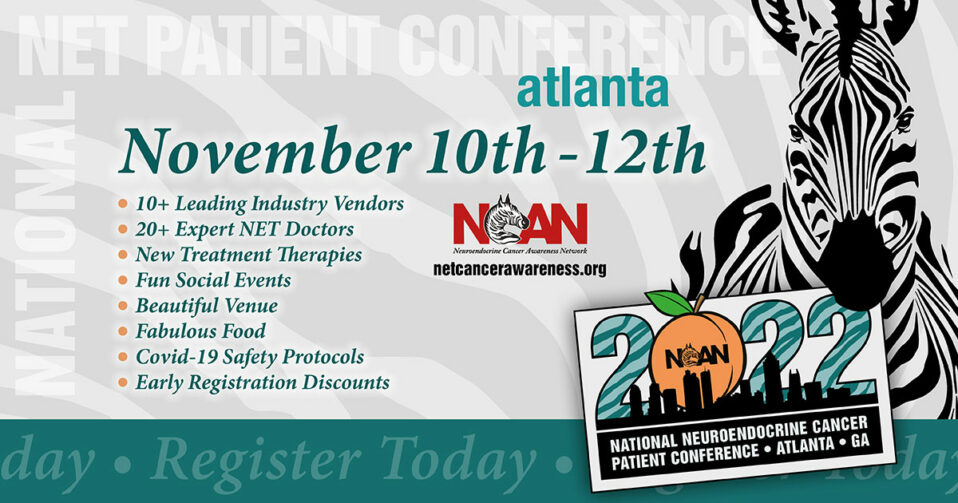
For those of you planning to attend NCAN’S National Conference in Atlanta November 10-12, October 9th is the last day to take advantage of the special reduced room rates at the Marriott Marquis Atlanta (our event location). There are limited rooms available at the discounted conference rate so REGISTER TODAY!

You won’t be sorry you did. It’s going to be epic, with 10+ LEADING INDUSTRY VENDORS, An exciting AGENDA featuring 20+ EXPERT NET DOCTORS, Information on NEW TREATMENT THERAPIES, and FUN SOCIAL EVENTS with opportunities to meet fellow patients and advocates. And if that isn’t enough, the Marriott Marquis Atlanta is a beautiful venue with two swimming pools, a gym, and a sports bar in case you need to release some pent up energy during the conference. And, being in the heart of Peachtree Center, the Marquis has an indoor connection to the Peachtree Center Station MARTA stop which is an easy, inexpensive subway link to the Atlanta airport.

We are really excited to be back together again and look forward to seeing you there!

October 16th is the NCAN deadline for ordering your exclusive 2022 STRIDE FOR STRIPES WALK ACROSS AMERICA T-shirts! This year, there are 2 designs from which to choose.

Since 2003 it has been NCAN’s passion to educate and support the NET community by raising awareness for NET, providing support for caregivers and people with NET, and funding NET cancer research. Strides for Stripes is one way we do all that, with your help. The 2022 Strides for Stripes Zebra Walk is set for November 20th, but the beauty of a virtual event is that you can walk any day, any time and any place you want!

And money you raise goes directly to programs that assist NET patients, such as our NET Cancer Hotline, Patient Conferences, and Educational Webinars. It’s important that you know it DOES NOT go to sky-high office rent and décor, or personal expenses.

Help us make a difference and REGISTER TO WALK HERE.

We are grateful for your support. And as always if you have any questions please CALL or E-MAIL us.

Find out more about how YOU can help the NET Community.


Disclaimer: NCAN blog posts are the opinions of its writers and are not intended as a replacement for medical advice. Please consult your Health Care Providers for individual concerns.

Read more

Preventing Patient Portal Panic.

September 1, 2022

By Anne Dabbs, 
NCAN TN Chapter Leader, NET Patient

PREVENTING PATIENT PORTAL PANIC.

Are patient portals a friend or a foe for you?
Originally met with some uncertainty by many physicians, the patient portal experience is becoming an efficient means of communication about your health.

The 2020 mandate to the 21st Century Cures Act is the blueprint of the patient portal access as we currently know in the US. This mandate was designed to ensure every patient in the US has prompt access to their clinical notes from their physicians. The earlier and larger legislation which started this process grew out of an “open notes philosophy “. These US Government laws were put into place to provide improvement in patient engagement and care quality.

There are numerous rules and exceptions which govern the use of our Electronic Health Records (EHRs). Some medical specialties have standing exemptions; others may exclude information on a case-by-case basis. Under the HIPPA Security Rule, we are assured reasonable and appropriate cybersecurity measures of our personal medical history. Medical facilities and individual medical offices may differ in their emphasis of using our patient portals.


TO MAXIMIZE THE POTENTIAL FROM A PATIENT PORTAL EXPERIENCE, WE MUST PRACTICE THE 5 P’s OF PREVENTING POTENTIAL PATIENT PORTAL PANIC:

1) Previous scans and labs can provide context for what you are getting ready to read in your newest entry. Before checking online, refresh your memory about what is the reason for your most recent activity. By doing so you will hopefully not be distracted by the sheer volume of information available and can focus on the important matters at hand.

2) Prepare a review sheet or a chart from previous labs and scans to highlight what is likely to have the most detailed descriptions. Have a quick and easy reference for values or images that might need evaluating.

3) Proper terminology familiarity is critical to understanding your reports. If you are still learning the basic language of a cancer diagnosis, make a cheat sheet of definitions. Make a point to become familiar with the stock phrases that are used such as in pathology reports. Learn which words prompt your anxiety, fear or misunderstanding, but are actually just medical jargon. Learn how to look up common medical abbreviations. Our NCAN website has an ever-evolving glossary of medical terms and abbreviations unique to our Neuroendocrine Cancer. It’s important to know that some medical phrases have a different definition when referring to Neuroendocrine Cancer. You can Google your lab work’s website to determine normal ranges for your lab work. WebMD, the NIH website, and the NCCN website are also good resources for proper terminology.

4) Practice the pause. When your patient portal entry has a finding in your report that is counter intuitive to everything you know about your case, take a deep breath, and remember that several people have contributed to this report and human error is a real possibility. Do not immediately jump to the conclusion that you have been lied to, etc. Fear and uncertainty are natural emotions for a cancer patient, but their intensity must be tampered down when reading results online. As patients of a rare disease, we must accept the reality that a large majority of the medical community is not overly familiar or current in their knowledge of Neuroendocrine Cancer and it’s rapidly increasing developments. Your local physicians and their clinical staff may not yet be current in your updated entries. Always ask for clarification first instead of accusing individuals of incompetence or negligence.

5) Proper Planning Prevents Poor Performance. Ask your physician how best to utilize your patient portal in communication with him and his office. Viewing and storage of your medical records is but one benefit. Many offices allow you to schedule appointments and request prescription refills via the patient portal. Some physicians prefer that you use your patient portal account as a quick question feature of communication rather than email or phone messages. Assess your personality and your comfort level with your disease. Medical terminology is hard to decipher until you are disciplined enough to educate yourself about your disease and it’s unique language. You owe it to yourself first, and to your physicians, to have the correct temperament to read your charts prior to having the results explained to you by a medical professional. Don’t create more stress by reading reports that might only alarm or frighten you. Wait for your physician’s explanations.

Used correctly, patient access to clinician notes through Patient Portals can improve patient safety and boost patient activism. It’s a wonderful tool to help us each become our own best advocate.

If you are looking to expand your self-advocacy toolbox, remember that NCAN is always HERE for you. Join us at our next EVENT. Check out the RESOURCE ROOM and let us help you on your NET journey.

Find out more about how YOU can help the NET Community.


Disclaimer: NCAN blog posts are the opinions of its writers and are not intended as a replacement for medical advice. Please consult your Health Care Providers for individual concerns.

Read more

Zebras Take Atlanta 2022.

August 1, 2022

By Anne Dabbs, 
NCAN TN Chapter Leader, NET Patient

AFTER TWO LONG YEARS, NCAN HAS REINTRODUCED THEIR IN-PERSON PATIENT CONFERENCES.

Three regional conferences earlier this year in North Carolina, Kentucky, and Michigan were met with great enthusiasm by patients and professionals alike. The joy of seeing old friends and meeting new ones was surpassed only by the wealth of knowledge shared in each location by highly respected Neuroendocrine specialists. Everyone is talking about how grand it is to be together again!


HERE’S WHAT THE PATIENTS HAVE TO SAY:

“A conference offers richer, broader, and deeper information, super efficiently. And connecting with my peer group is incredibly helpful.” —Newly Diagnosed Patient

“Thanks to my first NCAN patient conference, I was on my journey to absorb every bit of information that my brain would allow. Each subsequent conference leads me further down the path to more knowledge and wisdom about my Nets.” —Patient dx 5+Years

“Attending one of the big conferences is simply amazing. You get to meet a lot of people just like you. You get the latest information from the doctors who are specialists in our cancer.” —Patient dx 5+ Years


MEDICAL PROFESSIONALS AND NEUROENDOCRINE SPECIALISTS ALSO SHARE IN OUR EXCITEMENT ABOUT ATTENDING NCAN PATIENT CONFERENCES:

“It is an honor to participate in an NCAN Conference. A big conference allows us to get the word out to more patients than we can possibly see in our clinical practices.” —NETs Oncologist Presenter, National Conference 2018

“Participation in an NCAN patient conference allows patients to see what we (the Neuroendocrine Specialists) are all about.” —Presenter, National Conference 2018

“A NCAN conference allows patients to interact with NET specialists and ask questions; it allows a camaraderie between patients and caregivers.” —NET Specialist, Multiple Presenter

“As a physician, I also enjoy interacting with colleagues and always continue to learn from them.” —Net Specialist Regional Conference 2022


ADVOCATES FOR NEUROENDOCRINE PATIENTS MAKE UP A SIGNIFICANT PORTION OF ATTENDEES AT OUR CONFERENCES. INDUSTRY REPRESENTATIVES AND FAMILY CAREGIVERS OFFER A SPECIAL INSIGHT INTO WHY ATTENDING AN NCAN CONFERENCE IS IMPORTANT AND BENEFICIAL FOR ALL: 

“I attend the conferences because I wholeheartedly support NCAN’s passion and dedication to raising awareness of Neuroendocrine Cancer and providing support for caregivers and patients living with Nets.” —Clinical Nurse in Patient Services

“Attending NCAN conferences provides the opportunity to meet other caregivers. It is so helpful to meet others who are willing to share their experiences in order to help the families of newly diagnosed Neuroendocrine patients.” —Spouse/Advocate 5+Years

“You can read much of the educational stuff after the event, but you won’t make those special connections, you miss the ‘feel’ of support and the specialnesses of the community without showing up.” —Advocate 10+Years

“Just like live music… you can listen to a CD, but nothing replaces the feeling of being there.”–Advocate 15+Years


This November 10th-12th, please join us in Atlanta for three days of education, support, fun, good food, excitement, and encouragement. Come prepared to learn from experts and from each other. Feel the magic as you meet others who share your concerns and your hopes. Help us lift our voices to bring awareness to Neuroendocrine Cancer.

REGISTER TODAY!

And, if you need some extra support between now and then, we are HERE for you.

Find out more about how YOU can help the NET Community.


Disclaimer: NCAN blog posts are the opinions of its writers and are not intended as a replacement for medical advice. Please consult your Health Care Providers for individual concerns.

Read more

Appointment Preparedness.

July 1, 2022

By Anne Dabbs, 
NCAN TN Chapter Leader, NET Patient

Patients who live with a chronic disease such as Neuroendocrine Cancer frequently remark that managing our disease is just as much work as a full time job. We agree whole heartedly! It is work; It takes a lot of effort and concentration which is often in short supply. 

Having a good rapport and healthy conversations with your  physicians is a basic goal for living well with a rare disease. Our doctors know this and value good communication, also. Talking about cancer and hearing about YOUR cancer can be difficult. We need to be fully engaged with our medical teams as we navigate this shared responsibility.

Developing a good rapport starts with a few basic steps on the patient’s part.


1) CREATE A COMFORTABLE ENVIRONMENT FOR CONVERSATION BY ARRIVING ON TIME FOR YOUR APPOINTMENTS WITH THE PROPER PAPERWORK COMPLETED IN ADVANCE.

One recommendation to minimize miscommunication is to have a designated notebook and calendar that accompanies you to every single appointment. If you store your medical information and  scheduling on a device, be confident and competent in your ability to recall the data you need in moments, not minutes.


2) WRITE DOWN ANY QUESTIONS IN ADVANCE, AT HOME, AND PRIORITIZE THE FIVE MOST IMPORTANT.
These are the concerns you bring to your doctor’s attention first, for your peace of mind. If you and your physician are unable to discuss these top five items, ask how you can get answers prior to your next appointment. Can you schedule an office visit whose sole intent is to continue this conversation? Are these topics that can be discussed and answered by his physician’s assistant or nurse practitioner? Is the Patient Portal an adequate means of continuing the conversation?


3) BE HONEST WITH YOURSELF AND YOUR PHYSICIAN, ALWAYS. 
It is our responsibility to present an accurate picture of our current status in daily life. Bring a written record of missed medications, daily anomalies, shortness of breath, etc. Do not be embarrassed to discuss the physical malfunctions of your digestive system. You need to fess up to your doctor if you do not take your medications as directed or cheat on your daily food recommendations. Your doctor can not do his/her best job for you unless he is aware of all the facts.


4) PLAN TO TAKE NOTES OR ASK PERMISSION TO RECORD YOUR CONVERSATIONS WITH YOUR CELL PHONE.
Let’s face it, some of us have trouble remembering what we ate for breakfast! Add a little “white coat” anxiety to the situation and recalling what was said at a doctor’s appointment, after the fact, can be a real challenge. Also, sometimes it hard to listen and absorb information while taking notes. Recording the visit (with permission) or bringing a friend/advocate to take notes for you can be helpful, too.


TEN FAST TRACK TIPS FOR ROUTINE APPOINTMENTS
1) Arrive on time, unrushed, and prepared.
2) Dress comfortably for your labs or procedures.
3) Arrive fed (or not, depending upon lab instructions).
4) Plan for and anticipate delays.
5) Prioritize your 5 most important concerns and bring Rx renewal needs with you.
6) Symptom changes to discuss with your physician: joint, bladder, or bowel pains; shortness of breath, sleeping difficulty, headaches or vision changes, changes in your medications, mental health, and physical inabilities.
7) Stay focused and be truthful with yourself and your doctor.
8) Try to voice your concerns and feelings in a positive way.
9) Repeat instructions back to your doctor and take notes as needed.
10) Ask for clarification, additional literature or an additional appointment for a more in-depth discussion and understanding of any new issues.


Lastly, listen to your physician with the intent to understand and to stay focused on your health concerns. Your 15 minutes is precious to you and to your doctor. And if  you need any support before or after  your doctor visits we  are HERE for you.

Find out more about how YOU can help the NET Community.


Disclaimer: NCAN blog posts are the opinions of its writers and are not intended as a replacement for medical advice. Please consult your Health Care Providers for individual concerns.

Read more

The Reality of Scanxiety And Ways To Manage It.

June 1, 2022

By Anne Dabbs, 
NCAN TN Chapter Leader, NET Patient

“Take My Breath Away”
“Every Breath You Take”
“The Air that I Breathe “

These were 3 of the songs which played through my headphones during my recent MRI scans.

Scanxiety is a relatively common buzz word in our Neuroendocrine social media sites. Is it real? Is it silly? How do I deal with it?

Scanxiety Can Be Divided Into Two Camps:
Those who are anxious about the results of the scans and those who are anxious about the actual scan itself. Both are valid concerns and both can be managed.

For those who fear the results, educating yourself about the needs for the scan and the possible outcomes can help manage anxiety. Good communication with your medical team is paramount and can lead to a confidence in their willingness and ability to guide you on your NETs journey, whatever results the scan may bring.
Trusting that they are always working in your best interest can lead to a sense of peace.

For patients who struggle with the scans themselves, the cause of angst and the solutions can be quite varied.

A CT scan for many is simply a matter of inconvenience. The dreaded Contrast drink before hand, the waiting, or the multiple images that might be needed, are typically not cause for great angst, just a seemingly major time drain.

A recent advent of several Radio-tracer scans are a source of protocol unfamiliar for many NETs patients. These uncertainties can be alleviated by a phone call to the facility and a short conversation with the nuclear medicine technicians. The scans themselves are fairly quick and typically uneventful.

MRI scans, however, can be a monumental source of anxiety for many patients. Claustrophobia is real and often times, not pretty.

If You Struggle With Claustrophobia Here Are 5 Tips That Can Help:

1) EDUCATE YOURSELF.

Call the radiology department to ask which type of MRI machine has been reserved for your scan. Ask about the availability of an open MRI machine or a Wide Bore MRI machine. Policies on being sedated may vary between facilities so make sure you know those options and arrive prepared.

An Open MRI machine is not a narrow tube and should not cause any claustrophobic emotions. A Wide Bore Machine is still a closed tube, but it’s opening diameter is approximately 70cm as opposed to the 50-60 cm diameter of a regular machine. 10cm is a huge difference in my claustrophobic mind!

The technicians are typically happy to answer any questions (even the dumb sounding ones) to help reduce your anxiety; it makes their job easier once you arrive.


2) DRESS COMFORTABLY AND DON’T BE RUSHED THE DAY OF YOUR SCAN.
Follow all dietary restrictions (they will vary between facilities) and plan a reward afterward.


3) ONCE YOU ARE ON THE TABLE, GET COMFORTABLE.
Let the technicians position you with pillows and wedges as needed. Ask that your arms be “swaddled” next to your body (or over your head) so that you can relax slightly without fear of brushing up against the tube walls. Ask for folded sheets to be placed under your arms to help keep them cushioned. Close you eyes BEFORE the table begins to move. Keep them closed the entire time, period. You can also ask for a small cloth to be placed over your eyes, if you prefer. Remember to breath through your nose, not your mouth.


4) LISTEN TO MUSIC.
Hopefully your facility has provided headphones with your musical choices to help muffle the loud noises. To distract yourself, count the songs. A typical radio selection lasts 4 minutes. Keep track on your right hand of the number of songs and use the left hand fingers to track the sets of five. This will allow you to track the length of time passed somewhat accurately without asking “are we done yet?” every 5 minutes.


5) THANK YOUR TECHNICIANS.
Genuinely and often. An attitude of gratitude goes a long way for the patient and the technicians. Your good experience is dependent upon their job performance.


If our goal is to live well with Neuroendocrine Cancer, we must accept the necessity and inevitably of scans and tests. This is an opportunity for a NETs patient to be a team player with their medical advisors. Increasingly, our Neuroendocrine specialists are relying on scans more than lab work to diagnose and manage this disease. If we expect them to perform their best for us, we must be willing and able to give them our best efforts as well.

We hope you will visit the NCAN Glossary to familiarize yourself with the variety of scans and their purpose or better yet, join us at an upcoming NCAN Patient Conference. Other Resources and Links for managing the emotional challenges are available as well. Remember, we are a phone call away and we are here to help.

Find out more about how YOU can help the NET Community.


Disclaimer: NCAN blog posts are the opinions of its writers and are not intended as a replacement for medical advice. Please consult your Health Care Providers for individual concerns.

Read more

Four Tips for NETs Spring Cleaning.

May 1, 2022

By Anne Dabbs, 
NCAN TN Chapter Leader, NET Patient

Physicians and psychologists tell us that a cluttered mind and a cluttered life can be detrimental for those living with a chronic illness. On a daily basis, Neuroendocrine Cancer takes up so much mental and physical space that life can quickly become overwhelming. Let’s do all we can to streamline those actions and thoughts which can distract us from a good quality of life.


1) NOW is the time to give yourself an assessment of how well you are living with your Neuroendocrine Cancer.
Winter is hopefully behind us. Spring time is always a season of growth and new beginnings. Take a few moments to look back along your NETs journey and mentally shelve the bad experiences in order to focus on those experiences which will continue to lead you forward.


2) ELIMINATE EXCESS.
Clear out your Neuroendocrine notebooks and files. Consolidate reports and shred duplicates. Compile a list of missing files to request from medical records departments. Join your physicians’ patient portals to utilize for record keeping and effective communication. Clean out your medicine cabinet and pill boxes. Verify expiration dates and make note of renewal dates for your medications. Properly dispose of expired medications and replenish your OTC medicines and supplies. Update your first aid kit.


3) TAKE INVENTORY.
Update your physicians’ contact information and medication lists. (Find Helpful Forms HERE) Schedule your annual appointments for the dentist, optometrist, primary care, and all other “routine” doctor visits. Schedule preventative health appointments, making sure you are current on shots and vaccinations. Request referrals for those health issues which have been overshadowed by your oncology obligations.


4) SET GOALS.
Be realistic in setting goals for diet selections and exercise ambitions. Acknowledge long term goals such as drafting a will; a Living Will; a Durable Power of Attorney for Healthcare. Being proactive in these matters early insures less future stress. Focus on what you can do to enhance your life. Join a book club, renew friendships, learn a new language, or plan a trip. Make time for fun. Let go of what you expected your life to be like right now and focus instead all that is good. Write down that which grieves you; then let it go to make room in your life and in your mind for the positive that will build you up.

And always remember that we, at NCAN, are here to help you live your best life with your Neuroendocrine Cancer. We have educational and support opportunities in place to offer assistance whenever you might need. Reach out if you need us.

Find out more about how YOU can help the NET Community.


Disclaimer: NCAN blog posts are the opinions of its writers and are not intended as a replacement for medical advice. Please consult your Health Care Providers for individual concerns.

Read more

5 Positive Thoughts While Living With Neuroendocrine Cancer.

April 1, 2022

By Anne Dabbs, 
NCAN TN Chapter Leader, NET Patient

1. NETS CANCER TYPICALLY IS A MARATHON, NOT A SPRINT.
In other words, pace yourself.
If you find yourself in the majority of Low to Mid Grade NET patients, you have the time to set forth a mindset that you will be living with this disease for many years. You have time to plan and educate yourself on your current and future treatment options. You have the need to develop a personally comfortable acceptance of your disease.


2. “THE WOUND IS NOT MY FAULT. BUT THE HEALING IS MY RESPONSIBILITY.”
This quote by Marianne Williamson can be empowering. Once you have moved past the shock of your NETs diagnosis, it is time to become proactive in your healthcare. It is your responsibility to work with your medical personnel to develop a healthy and productive dialogue. It is your responsibility to understand your physicians’ recommendations and instructions. It is your responsibility to follow those instructions. It is time for honest communication with your physicians and family.


3. MAKE TIME TO MARCH IN THE SECOND LINE.
In New Orleans, the Second Line Band is a treasured symbol for moving forward following a tragedy. A Jazz funeral is comprised of two bands. The first band marches behind the family and plays slow, somber songs to respect their grief. But as the last sorrowful trumpet note sounds, the drum beat of the Second Line (band) picks up the cadence and the music is played to celebrate a well lived life. The Second Line is a reminder to live a joyful life. It is an invitation to celebrate life. Many cancer patients enter a phase of mourning following their diagnosis. This is normal and even healthy. But, as the Second Line teaches us, give your grief the respect it deserves, but set your sights on the possibilities of joy.


4. “DON’T LET YOUR STRUGGLE BECOME YOUR IDENTITY. “
This quote by American poet and songwriter, Ralston Bowles, gives us insights into life’s many struggles. Big or small, infrequent or chronic, struggles must be addressed and resolved so as not to become bogged down by them. It is imperative to retain a sense of self worth and identity if we want to live well with NETs. We need to skillfully categorize our struggles. Hold the little issues close and deal with them quietly, perhaps. Share your larger struggles with those who are equipped to offer you support and encouragement. Share your biggest struggles, mental and physical, with your physicians.


5. “FALL DOWN SEVEN TIMES, STAND UP EIGHT.”
This ancient Japanese proverb is a timeless, well worn piece of advice. It is appropriate in any of life’s situations, but especially in the life of a cancer patient. The shortened version of these 7 words is HOPE.

Without hope, no amount of positive thinking is beneficial.
Hope is what allows us to mourn and continue to move forward.
Hope challenges us to be our own best advocate.
Hope invites us to share in the responsibilities of our healthcare.
Hope encourages us to be reminded of our healthier selves with the intent to reclaim that identity again.
Hope says never, ever give up.
Hope affirms that perhaps today wasn’t my best day, but I will try again tomorrow.

At NCAN, hope is part of our mission; it’s why we exist.
If you need help in any way, REACH OUT, we are here for you.

Find out more about how YOU can help the NET Community.


Disclaimer: NCAN blog posts are the opinions of its writers and are not intended as a replacement for medical advice. Please consult your Health Care Providers for individual concerns.

Read more

“Tell Me, and I Forget. Teach Me, and I Remember. Involve Me, and I Learn.”

March 1, 2022

By Anne Dabbs, 
NCAN TN Chapter Leader, NET Patient

“Tell Me, and I Forget. Teach Me, and I Remember. Involve Me, and I Learn.” – Benjamin Franklin

As soon as you hear your physician utter the words, “You have Cancer”, your brain stops.

It shutters with horror and disbelief. Then, it slowly kicks into overdrive trying to absorb the shock and the strange new terminology that accompanies this diagnosis. You will be asking a lot of medical personnel to repeat themselves and to explain things over, and over, and over, again. You FORGET all, but the essentials to emotionally deal with your new reality.

Next, all of those new medical terms become just familiar enough that you can start reading about your disease, and talking with others who have a similar diagnosis. You begin to REMEMBER the highlights of NETs in general, and the specifics of your own case, as needed.

Hopefully, you then become a contributing member of your own medical care team. You recognize the need to become aware of the broad scope of your diagnosis. And, in order to LEARN more about the complexities of Neuroendocrine Cancer, you will choose to be involved and continually educated by NET experts.

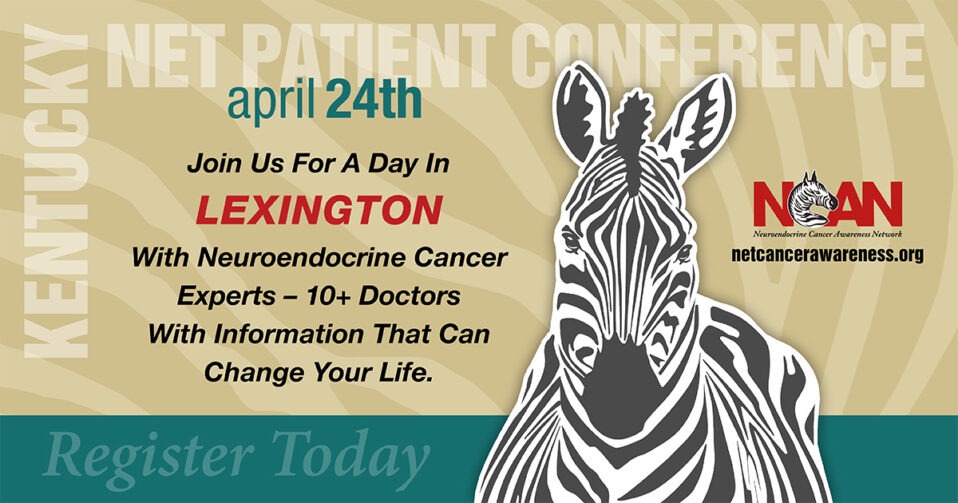
On Sunday, April 24th NCAN is, once again, hosting a Regional Patient Conference in Lexington, KY. A one day program with a slate of physicians and advocates speaking on a diverse selection of topics. This opportunity is valuable for the newly diagnosed, established NETs patients, family and advocates.

NCAN has long recognized the need for well informed patients. Our conferences bring patients and NET Specialists face-to-face so they can become informed, engaged, knowledgeable, and empowered self advocates.

We invite and encourage you to join us in discussions with experts, to network with other patients, and to become involved in building a better Neuroendocrine Community for all of us.

Click HERE to see the agenda, and make your reservations today.

And as always, if we can help in any way, please REACH OUT to us. We are here for you.

Find out more about how YOU can help the NET Community.


Disclaimer: NCAN blog posts are the opinions of its writers and are not intended as a replacement for medical advice. Please consult your Health Care Providers for individual concerns.

Read more

12 Ways to Say “I Love You” to Your NETs Caregiver.

February 1, 2022

By Anne Dabbs, 
NCAN TN Chapter Leader, NET Patient

There’s a popular saying that “When a person has cancer, the whole family has cancer”. There is a lot of truth in that statement. Having family and friends who care and can empathize with us is paramount to our well being. Making sure our caregivers and advocates know they are appreciated, loved, and respected is equally beneficial to a life well lived with a cancer diagnosis.

A recent online NETs patient conversation reminded us of how important it is to make sure we let our caregivers/advocates, know how much we appreciate them.

From patients and caregivers, we give you 12 ways to say “I love you” on Valentine’s Day and everyday!

1) HUGS. Big and Frequent or Small and Sincere.
Nothing says I love you like wrapping your arms around someone and holding on tight. A quick clasp of a hand can also show solidarity in a stressful situation. You feel good. They feel good. It’s a win, win for all.

2) Honest Communication.
When discussing cancer and emotions, it’s imperative to always be honest. Admitting that you need help, and gratefully accepting it when offered, is a sincere expression of gratitude. Your honesty will also transfer to your caregiver’s ability to talk frankly and sincerely. Honesty provides a safe place where you can cry together and laugh together.

3) Say “Please and Thank You”.
In the day to day management of your NETs, it can become easy to take your advocate for granted. Manners matter. Remember those basic social skills to communicate your gratitude and appreciation. Say it sincerely, and say it frequently. Gracias, Merci, Gracie, Danke, Thank you!

4) Prioritize Free Time.
Supporting someone with a chronic disease can be overwhelming, mentally and physically. Encourage your advocate to make time for him/herself. Time for them to recharge their energies is imperative. If invited, take an genuine interest in their hobbies.

5) Apologize When Necessary.
It’s inevitable. We all make mistakes. We say the wrong thing; we do the wrong thing. Make the effort to say “I’m sorry, I’ll do better next time.”, and mean it. Conversely, accept your caregiver’s apologies and shortcomings. There is no space in the NETs World for holding grudges.

6) Show Appreciation. Always.
Actively showing your appreciation for your caregiver is important. Your words, your actions, even your thoughts will let them know your sincerity. Homemade cookies and treats and favorite dinners speak to love and thanksgiving and are undeniably a favorite. Unexpected gift cards or watching a treasured movie can bring joy in a simple expression. Offering support for their other responsibilities such as child or grandchild care is a gift of the highest appreciation.

7) Switch Focus. Ask, “How can I help YOU?”
Let’s remember to turn the tables and make sure our caregivers’ needs are being met also. This attitude shows that we have an idea of the sacrifices they make on our behalf. A simple question and genuine response can make all the difference.

8) Don’t Yell at Your Caregiver While in the Hospital.
Actually, don’t yell at your caregiver at all. But especially in stressful situations such as a hospital visit. More than likely, they are stressed out too. Respect and patience are essential to good communication while stressed. And, If you do lose it, refer to #5, as soon as possible.

9) Complement Your Caregiver.
Let’s face it, everyone wants to know when they are doing a good job. Say something nice about them to their face and in public. Let their family and friends know how much you value your caregiver.

10) Keep Expectations Realistic.
Educate yourself and your advocate about your NETs. Make sure you both have realistic and shared expectations about your health, your abilities, and your care. These discussions will help your advocate best support you. They will be enabled to better encourage you or discuss concerns with honest and sincere expectations.

11) Simply Say, “I Love You”.
We think it. We write it. We feel it. We show it in our actions. It’s always there, hanging on the tip of our tongue. Let it fly! Say, I love you! Say it proudly and say it often.

12) Understand that Your Neuroendocrine Cancer has Changed Their Life, Too.
Having Neuroendocrine Cancer can be a long, tiring, and often confusing journey. So is loving and caring for someone on that journey. Combine efforts to insure that this journey you are taking together is filled with joy, love, and appreciation.

If your caregiver would value the camaraderie of conversations with other advocates, encourage them to join the NCAN Caregivers Facebook group.

Just another way to say I love you and I appreciate you!

And, if you need us, reach out. We are always HERE  for you.

Find out more about how YOU can help the NET Community.


Disclaimer: NCAN blog posts are the opinions of its writers and are not intended as a replacement for medical advice. Please consult your Health Care Providers for individual concerns.

Read more

Keeping a Healthy Perspective.

January 1, 2022

By Anne Dabbs, 
NCAN TN Chapter Leader, NET Patient

Back in the old days, we learned to draw interior illustrations by hand, at a drafting table, late at night with a pot of black coffee, and a stack of albums on the record player. These 2D illustrations showed the perspective of an interior space making it feel 3 dimensional.

I never imagined, as a college sophomore, that my drafting lessons would be inspiration for future coping skills to deal with my Neuroendocrine Cancer. Drawing and thinking in perspective allows you to focus on the issues closest to you and to recede the items placed in the background. That which needs the most attention is placed in the foreground and the supporting details in the background.

How do you put your Neuroendocrine Cancer into perspective? 
What issues or concerns are in your foreground? 

Is your zebra large and looming in your life, or tucked away in the background, coming into view only on occasion? Not every issue needs your full attention 100% of the time. It is ok to examine your health status and put some issues into the background from time to time. We can train ourselves to prioritize things which must be dealt with daily. They belong up front, and center. The little, annoying issues that collectively jumble up our thinking can be placed into the background. Not hidden or forgotten, just sent aside until the mental and/or physical energy exists to deal with  them. 

A perspective helps visualizes a space as fluid as well. Spaces evolve; health issues do too. Some weeks my zebra pulls up a chair and demands my attention. Other times, he sits on a shelf in the background, nearly forgotten.

As much as my training and professional life have contributed to my coping skills for living with this incurable disease, I am always looking for more helpful hints.  What have your life experiences taught you about living in the world of Neuroendocrine cancer? What skills can you share here to help others?  How do you keep your expectations in a healthy perspective?

If you need help keeping your NETs journey in perspective, give us a call, we are here for you.


Find out more about how YOU can help the NET Community.


Disclaimer: NCAN blog posts are the opinions of its writers and are not intended as a replacement for medical advice. Please consult your Health Care Providers for individual concerns.

Read more

The Gift of Comfort and Joy.

December 1, 2021

By Anne Dabbs, 
NCAN TN Chapter Leader, NET Patient

“Comfort and Joy” is a cheerful and popular refrain this time of year, but sharing comfort and joy can be a daily endeavor.

Talking about comfort with an incurable cancer community is not exactly an easy task. Yes, we may have the “good cancer”; Yes, we may not look like cancer patients, but many in our Neuroendocrine Community are not assured physical comfort. And still others struggle  with a lack of emotional comfort. Comfort is not a given, especially with a cancer diagnosis. But what we do have is the ability to offer each other the gift of comfort.

Everyday our Facebook NETs groups are flooded with patients reaching out to reassure others, to offer encouragement, to show solidarity in the many facets and complexities of living with NETs. If comfort as a noun alludes us, then let’s try to find comfort as a verb. I have lived long enough to learn that in offering a gift of comfort, I, too, will know comfort. What we give, we receive.

The same is true for Joy. Joy is an all encompassing emotion. It is easy to give and a delight to receive, especially when there is joyful, hopeful news among our NETs friends. For those of us whose Neuroendocrine journeys do not include points of extreme satisfaction or jubilation, we can find joy in the smaller, but equally valuable bits of contentment, humor, and happiness. Joy is contagious and always arises out of gratitude. “We are not thankful because we’re joyful; we’re joyful because we are thankful.”

When I think of Comfort and Joy, the words of Ralph Waldo Emerson  come to mind:

“Write it on your heart
That each day is the best day of the year…”

Tidings of Comfort and Joy from all of us at NCAN. And remember, if you need us, don’t hesitate to reach out. We are HERE for you.


Find out more about how YOU can help the NET Community.


Disclaimer: NCAN blog posts are the opinions of its writers and are not intended as a replacement for medical advice. Please consult your Health Care Providers for individual concerns.

Read more

What’s Your NETs Elevator Speech?

November 1, 2021

By Anne Dabbs, 
NCAN TN Chapter Leader, NET Patient

In the time it takes to share a greeting on an elevator with a stranger, we need to have a description for our rare, incurable disease that does not lead the listener to a “deer in the headlights” reaction. This year, for NET CANCER AWARENESS DAY, we are asking everyone to begin crafting their personal elevator speech.

We need to be ready to tell our cancer story concisely and correctly every time we have the opportunity to share awareness of Neuroendocrine Cancer.

Strangers, new acquaintances, even some family and friends need to know just enough so they are motivated to encourage and support us, and to be sincere in their efforts to want to help us. INCREASING AWARENESS is central to our Neuroendocrine community’s expansion into the world of research. Heightened awareness benefits patients, physicians, and researchers as it leads to enhanced education, improved diagnostic tools and additional treatments.

What have I learned in five years of crafting my elevator speech?

I never begin by stating that I am a Stage 4 cancer patient. A casual listener will immediately start looking for signs of my demise. The subsequent comment about Grade 1 is wasted. Stage 4 NETs cancer typically does not equal Stage 4 prognosis of more well known cancers.

I rarely tell the location of my primary tumor as that (important to me) detail immediately will erroneously classify me as a colon cancer patient.

And I avoid details of my monthly SSA injections which will likely involve a long winded, unnecessary discussion about chemotherapy (SSAs are a hormone therapy).

Make your words count in the effort to raise awareness about Neuroendocrine Cancer so that others will be motivated to help.

“I have a rare, incurable, but treatable Neuroendocrine Cancer diagnosis. It has metastasized to many locations in my body, but it is a very slow growing cancer. With proper surveillance and a treatment plan crafted for me by my specialists, I anticipate a reasonable life expectancy. Thankfully, with increased awareness and research, new developments are giving us hope for earlier detection and improved treatments every year.”

I have shared my personal elevator story with you in hopes that you will share yours in the comments below. Together we will work to raise our voices for our Neuroendocrine community. Together we will make a difference.

And, as always, if you need anything we are HERE and ready to help.


Find out more about how YOU can help the NET Community.


Disclaimer: NCAN blog posts are the opinions of its writers and are not intended as a replacement for medical advice. Please consult your Health Care Providers for individual concerns.

Read more

Five Years AD. (After Diagnosis)

October 1, 2021

By Anne Dabbs, 
NCAN TN Chapter Leader, NET Patient

The last Wednesday in July, I passed the important milestone of 5 years since I received my Neuroendocrine Cancer diagnosis. That occasion, however, was overshadowed as we celebrated our oldest grandchild’s fourth birthday. Talk of tutu wearing unicorns replaced any thoughts of cancer by everyone in my family but me. And I am so thankful for that! I have no time, no need, and no desire for a pity party.

Five years ago, my world turned upside down. I thought life as I knew it was over. A year later, almost to the hour, I held my first grandchild, and once again my life turned upside down. Or maybe, rightfully, it returned to right side up!

My life is different now; in many ways for the better. Having Stage 4 Neuroendocrine Cancer makes one acutely aware of life’s checks and balances. I take more time for the little things, and I allot less time to the energy burners. I have learned how to prioritize my time and energy. I have learned how to put my needs first when necessary. I have learned that I need less, and my wants are even fewer.

My family has been, and will continue to be, my biggest supporters and greatest strengths. We are a prime example of the saying that “There may be only one patient, but the whole family has cancer”. I am proud of how far we have come in accepting my NETs into our lives without letting it destroy our happiness these past five years. I am confident that whatever NETs throws our way, we have made it this far with a healthy determination to live life to the fullest, and we will continue to do so.

Amid the swirls of pink and purple streamers, tutu wearing grandparents and cousins full of unicorn cake, I had my private moment of awe that I have surpassed my initial, mis-informed, prognosis of 3-5 years. I took my time to reflect on all that I have received, and all I have yet to accomplish. Never to be NED, cancer is my constant companion now. But, it is no longer the 24/7 focus of my attention. I had a moment of quiet thanksgiving and private recognition for my journey thus far. As I returned to the festivities around me, I reaffirmed my knowledge that I am not alone as I live with my disease.

We here at NCAN want you to know that you also are never alone in your Neuroendocrine Cancer journey. Our hotline, our local support groups, our website and our events all bring support and encouragement to those who travel this path. Whether you are newly diagnosed, or an experienced patient, we want to be a part of your dazzle. When you need an answer to a question, clarification of a medical term, or a listening ear, NCAN is with you every step of the way.

Reach out if you need us. It’s what we are here for.


Find out more about how YOU can help the NET Community.


Disclaimer: NCAN blog posts are the opinions of its writers and are not intended as a replacement for medical advice. Please consult your Health Care Providers for individual concerns.

Read more

Imagination. Friend or Foe?

September 1, 2021

By Anne Dabbs, 
NCAN TN Chapter Leader, NET Patient

I’ve had a quote of Albert Einstein’s posted on my refrigerator for several years. It sums up my life as the wife and mother of engineers.

“Logic will get you from point A to point B.
Imagination will take you everywhere.”

I’m the artsy, spontaneous, creative thinker living amongst the logical, analytical, rational thinkers of my family.
Recently, following my Neuroendocrine diagnosis, a new quote, attributed to Deepak Chopra, has become more appropriate:

“The best use of imagination is creativity.
The worst use of imagination is anxiety.”

In my academic and professional lives, my creativity and my imagination were distinctive and beneficial. Now, my imagination gets me into trouble as I navigate my life as a Neuroendocrine Cancer patient. I know I am not alone in this scenario.

Twenty seven days in a row, I will be going about my days with rarely a thought about MY cancer, but on that 28th day, as I approach the oncology parking lot, my imagination starts going into overdrive. For the 4 previous weeks, I have creatively managed my activities to insure adequate rest and exercise. I have creatively crafted my meals to make good low amine food choices. I have used my imagination to maintain a volunteer presence in our NETs groups and to manage my family life and social time. But, on that 28th day, my creativity turns into anxiety. What will my blood work show? Will the nurse administer the shot correctly? Will the oncologist want to order new scans? What does he know that I don’t know? These are the thoughts that rob my sleep and steal my creativity.

What can we tangibly do to keep our anxieties under control?
• Educate, educate, educate yourself about your specifics of NET Cancer.
• Own it. Do not let a lack of knowledge or disinformation own you.
• Ask questions.
• Consult with and/or learn from a Neuroendocrine Specialist.
• Be your own best advocate and learn from those who understand it the best.
• Identify your support team.
• Be a support person for another NETs patient; join an NCAN support group. Start an NCAN support group.

Use your imagination and your creativity to develop lines of communication which will allow your family and friends to work with you to best understand your needs and your abilities while living with Neuroendocrine Cancer. And Remember, NCAN is always here for you. Call us. Write to us. Reach out when you need to, we are here and ready to help.


Find out more about how YOU can help the NET Community.


Disclaimer: NCAN blog posts are the opinions of its writers and are not intended as a replacement for medical advice. Please consult your Health Care Providers for individual concerns.

Read more

Medical Mystery Tour.

July 20, 2021

By Anne Dabbs, 
NCAN TN Chapter Leader, NET Patient

Do you ever get a song stuck in your head that just won’t go away? It might be a favorite tune or a totally irrelevant commercial jingle. This week, the Beatles’ “Magical Mystery Tour” has taken up residence in my brain, except I have read something which has caused me to alter it to “Medical Mystery Tour”. Isn’t that appropriate for a Neuroendocrine Cancer patient!

To exorcise these altered lyrics from my head, I did some research and learned that Paul McCartney once said that he and John were fascinated by the idea of getting on a bus without knowing their destination. Well, That certainly sounds familiar!

This album was the release of some of the Beatles’ most iconic songs. A fan wrote that the highly popular “All you need is Love” was the Beatles’ message to us that we should not see life as full of obstacles, but rather opportunities. Who me, a cancer patient?

By this point, my association of this album to my disease was becoming clearer. My Neuroendocrine diagnosis has certainly been a mystery at times. The journey can be clear one day and distorted the next. I truly try to see this journey as an opportunity rather than an obstacle, as hard as that may be some days. And, I hope I can encourage other patients to do the same.

One particular article stated that the Beatles considered “All you need is Love” to be a revolutionary song, which brought home this message to me. They thought of this song as a lesson, to learn to love and accept ourselves as we are, because “There’s nowhere you can be that isn’t where you’re meant to be”. Truth.

So many of us have no idea what chain of events prompted our Neuroendocrine cells to go haywire. We must accept the fact that we may never know the reasons why. But, the more we learn how to live well with our disease, the more we can be open to the opportunities it presents.

So yes, I have accepted that I am where I am supposed to be, and I will make the journey as joyful as I can. By accepting my diagnosis instead of fighting or ignoring it, I intend to be the best that I can be. And, I hope you will sing along with me.

If you need support of any kind, please reach out to us. That’s what we are here for.


Join us on September 30th – October 2nd for the 2021 National Neuroendocrine Cancer Patient Conference in Atlanta. REGISTER TODAY!


Find out more about how YOU can help the NET Community.


Disclaimer: NCAN blog posts are the opinions of its writers and are not intended as a replacement for medical advice. Please consult your Health Care Providers for individual concerns.

Read more

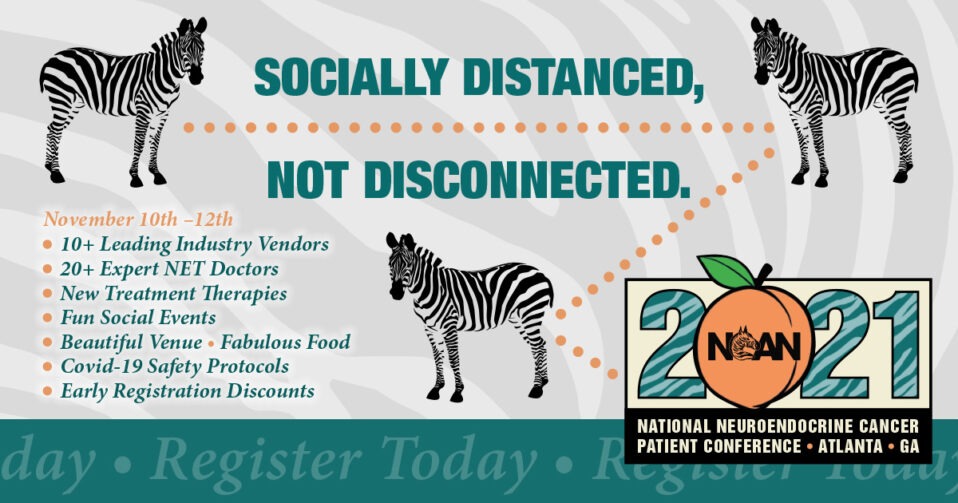
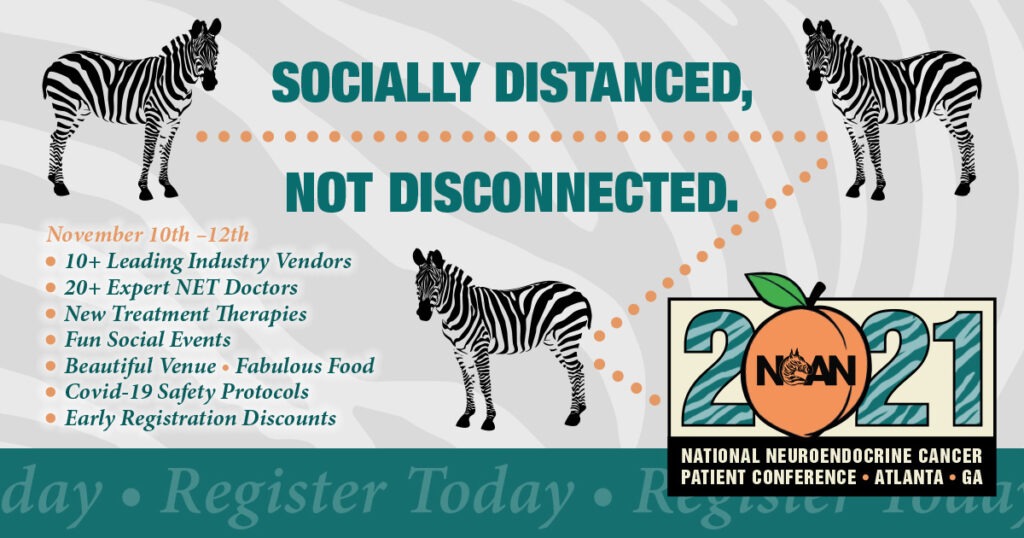
Socially Distanced, But Not Disconnected.

July 1, 2021

By Anne Dabbs, 
NCAN TN Chapter Leader, NET Patient

The invitations to present have been accepted. The meeting rooms are booked. Social distancing guidelines and Covid 19 safety provisions have been established. The registration for the 2021 NCAN National Conference is now open! It is time for Neuroendocrine patients, caregivers, and advocates to make plans to attend! The Atlanta Marriott Marquis will be our place to dazzle for 3 days beginning September 30th-October 2nd. The excitement and bright lights of Atlanta are a perfect location for us to reconnect in person.

CONNECT WITH OPPORTUNITY
Approximately two dozen specialists and advocates will give us multiple opportunities to listen, learn, and connect as they discuss treatments, research and new developments in our community. The question and answer sessions allow patients to submit questions for our experts and hear real time answers and discussions between the presenters. What an opportunity to hear potentially differing opinions or techniques. This year’s itinerary includes a wide array of topics, including several not presented in recent years.

The Exhibit Hall will feature many of the pharmaceutical companies whose representatives, literature and presentations will answer questions that may have previously alluded us. Frequently these booths include handouts and “swag” items.

CONNECT WITH VALUE
This year’s Early Bird registration fee is $125 per person if you register by August 15th. An expansive buffet is included during the Thursday evening Welcome Reception. This gathering allows the attendees to mingle with other patients and presenters in an informal setting. Registration includes breakfast, lunch, plus snacks during the twice daily breaks Friday and Saturday. If you have ever traveled on a company’s per diem budget, you will appreciate this amazing value! Also included will be a light buffet and live entertainment via a Zebras Have Talent show. This will be featuring comedy with the incredible Steve Mazan a NET Patient himself. There will also be singing and dancing by other talented NET patients on Friday night.

The Early Bird registration fee expires on August 15. Registration after that time will be $150 per person which is still an incredible value for the many perks you will receive.

The Atlanta Marriott Marquis has a limited number of rooms available at a NCAN discounted price of $159/night +tax when booked by September 8th. The facility has two swimming pools, a gym, and a sports bar just in case you need to release some pent up energy! Being in the heart of Peachtree Center, the Marquis is an easy 3 minute walk from the closest MARTA station whose one way fee from the airport is only $2.50.

CONNECT WITH AN INVESTMENT
This conference is an investment in your health. A NCAN Patient Conference is an astonishing place to learn how to live smarter with Neuroendocrine Cancer. If you have ever felt isolated, or minimized due to this disease, this is your opportunity to correct that. The educational information presented is the highlight of the conference, but most attendees will agree that the friendships developed by meeting other patients is an equally compelling reason to attend. A NCAN conference is also an investment in your mental health and is an experience like none other.

We will refresh our knowledge and gain insight into new developments. We will meet and greet many of our most highly respected specialists while making new friends. We will spend 3 days together investing in our well being and acquiring the tools we need to self advocate. It will be time and money well spent much like other investments we make on behalf of our families and our careers.

Please join us in Atlanta on September 30th. You will leave smarter, wiser, and more confident. It will be fun. It will be entertaining. It will be invaluable. Let’s reconnect with one another while learning to live well with Neuroendocrine Cancer. We are looking forward to meeting you in Atlanta!

CLICK HERE  for more information, or to Register Today!


Join us on September 30th – October 2nd for the 2021 National Neuroendocrine Cancer Patient Conference in Atlanta. REGISTER TODAY!


Find out more about how YOU can help the NET Community.


Disclaimer: NCAN blog posts are the opinions of its writers and are not intended as a replacement for medical advice. Please consult your Health Care Providers for individual concerns.

Read more

But Who’s Counting Anyway?

June 1, 2021

By Anne Dabbs, 
NCAN TN Chapter Leader, NET Patient

Numbers can have a grip on our lives, and frequently, our minds. Speed limits, gas prices, GPA’s, anniversaries. We count and tabulate numbers many times a day. I still remember a dozen or more childhood phone numbers. The numbers on a bathroom scale can haunt me for days. Last week I did some of my best counting ever as I sang a lullaby to our grandson.

“Two plus two is four.
Four plus four is eight.
Eight and eight are sixteen.
Sixteen and sixteen are thirty-two”

I quickly lost track of how many times I sang this slow melodic chorus before he fell asleep.

When I was newly diagnosed with Neuroendocrine cancer, counting took up a lot of time and space in my head. My emotions rose and plummeted with my monthly lab work. A slight nudge in either direction could cause angst or celebration. I charted those numbers like the statistician I could have been. My weight fluctuated all over the place and the countdown to scans was nerve wracking. I have thankfully mellowed these past five years. I finally understand that, for me, my NETs journey truly is a marathon, not a sprint. My current state has become comfortable enough for me that I no longer stress out over singular lab work numbers or slight hiccups in my care.

I have learned to set my sights on the old adage, “Don’t count your days, Make your days count”. I try to embrace each day for what it has to offer me. Some days are more productive than others. Some are more creative and social than most. Some days I simply must be a couch potato. But each day has the potential to be enjoyed. And, if we can release our minds from the tally of our days, we will find the ways to make each day count.

If we can help in anyway, don’t hesitate to reach out. You can count on us.


Join us on September 30th – October 2nd for the 2021 National Neuroendocrine Cancer Patient Conference in Atlanta. REGISTER TODAY!


Find out more about how YOU can help the NET Community.


Disclaimer: NCAN blog posts are the opinions of its writers and are not intended as a replacement for medical advice. Please consult your Health Care Providers for individual concerns.

Read more

A Lightbulb Moment.

May 1, 2021

By Anne Dabbs, 
NCAN TN Chapter Leader, NET Patient

“There are two types of tired. One that requires rest and one that requires peace.” — Lauren Fortenberry.

All of our Neuroendocrine Specialists will tell you that the overwhelming number one complaint they hear is fatigue. There is the physical fatigue that is imposed upon our bodies by our cancer. And there is the mental exhaustion as we try to live “normally” with our chronic disease. Some of it is cyclical and revolves around our treatments, while some is driven by the very real scananxiety that most of us experience at one time or another. Some of our exhaustion stems from the challenge and burden of learning an entirely new medical language. Much of our fatigue is from external sources, but we also have the capacity to churn ourselves into a state of exhaustion by not managing our thoughts about Neuroendocrine Cancer.

Many of our long time thrivers will admit to having a light bulb moment about their diagnosis. It may be an initial emotion following a ridiculously long diagnostic period. Others have had to work determinedly to achieve an inner peace with their disease. I think all of those who are living well with their NETs for many years will agree that a light bulb moment of acceptance was pivotal in their journey. It was a moment of peace with their new normal.

What was your light bulb moment? Can you identify the situation, the person, the test results that allowed you to become hopeful and joyful again? Can you remember the release of continuous stress leaving your body as you realized “Hey, I can do this!”? Can you retrieve that moment of survivor mentality to help boost yourself up again and again when needed?

Can you share your lightbulb moment with other NET patients struggling to adapt to their diagnosis? If you can verbalize it, I hope you will. If you can write it down, I hope you will. If you can act upon it, please do. We all need a ray of hope, a shining light of encouragement.

Raising awareness of Neuroendocrine Cancer is beneficial to us all. The developments in treatments and testing are progressing at a very rapid pace, and our community is growing in numbers and in knowledge. We need to be ready to help patients who are struggling to accept their diagnosis. By sharing our stories, we change the focus from “I” to “we”. Then, we can work together to turn “illness” into “wellness”.

Share your lightbulb moment below or on the NCAN FB page. Your light may be exactly what another zebra needs to hear.


Find out more about how YOU can help the NET Community.


Disclaimer: NCAN blog posts are the opinions of its writers and are not intended as a replacement for medical advice. Please consult your Health Care Providers for individual concerns.

Read more